12 Best Productboard Alternatives in 2026 (Honest Guide + When to Use Each)
Productboard has become powerful, but also expensive and heavy for many teams, especially smaller SaaS companies and startups that need focus over complexity. If you're feeling that friction, there are plenty of lean, modern alternatives that cover roadmapping, feedback, and stakeholder alignment without requiring a six‑month rollout.
Below are 12 strong Productboard alternatives, including your own app, Wey, with clear guidance on when each actually makes sense.
Quick overview
| Tool | Best for | Standout strength |
|---|---|---|
| Wey | Strategy‑first teams who want simple, clear roadmaps | Strategic clarity and beautiful visuals |
| Aha! | Enterprise product orgs with complex portfolios | Deep strategy and portfolio management |
| Canny | Public feedback + simple roadmap | Feedback boards and voting |
| ProdPad | Idea flow and discovery work | Outcome‑based roadmapping |
| Airfocus | Prioritization‑heavy teams | Flexible scoring and prioritization |
| Jira Product Discovery | Teams living in Atlassian/Jira ecosystem | Tight link between discovery and delivery |
| Roadmunk | Presentation‑ready roadmaps | Strong visual roadmap presentations |
| ProductPlan | PMs who mostly need timelines and swimlanes | Clear classic roadmaps |
| UserVoice | Mature B2B products with lots of feedback | Research‑grade feedback and portals |
| Pendo | Data‑driven teams with in‑app UX focus | In‑app analytics and guides |
| Trello | Very small teams and early‑stage founders | Ultra‑simple boards |
| Asana | Teams blending project and product work | Strong execution and task management |
1. Wey – Strategic Product Roadmaps without the Bloat
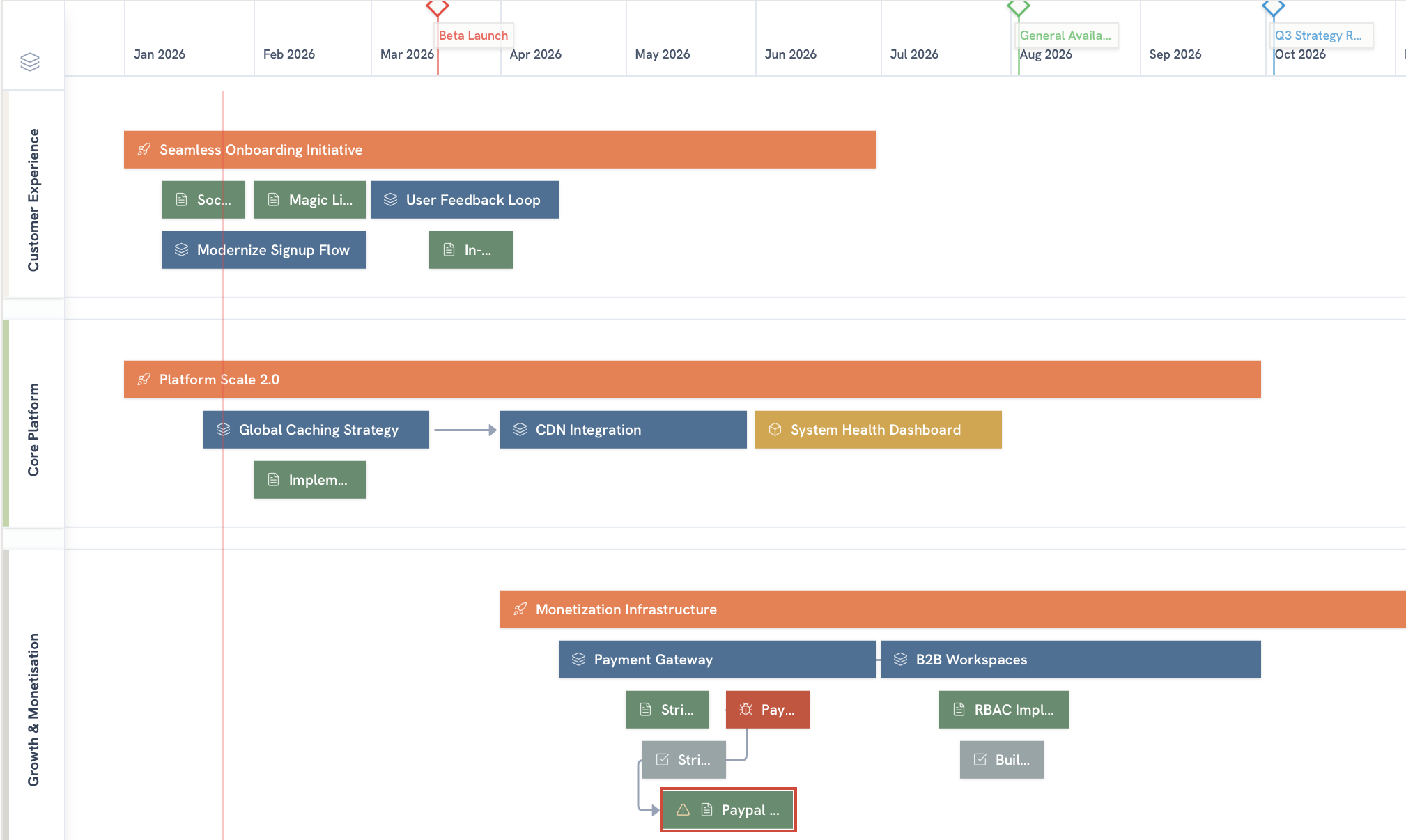
Wey is a strategy‑first roadmap tool designed for teams that want to think clearly about priorities and tell a simple, compelling story about where the product is going. It focuses on strategic alignment rather than trying to be an all‑in‑one feedback, analytics, and delivery platform.
What it does well
- Clean, visual roadmaps that are easy to understand for leadership and non‑technical stakeholders. Share with one-click links — no login needed.
- Goal/initiative‑driven structure that keeps work tied directly to strategy instead of a feature wishlist.
- Lightweight collaboration so the product team can align with sales, marketing, and engineering without process overhead.
Where it's not trying to compete
- It's not a full feedback aggregation or research repository tool yet.
- It doesn't replace your issue tracker (Jira, Linear, etc.), and that's intentional – it sits above them as the strategic layer. You can import from Jira to bring in existing work.
Best for
Use Wey if:
- You feel stuck in endless backlog grooming and want a clear, story‑driven view of your product strategy.
- You need something credible in exec and board meetings, without needing a dedicated admin to keep it updated.
- Your feedback and delivery tools are fine, but you're missing a calm, opinionated strategy layer.
Avoid it if you want a single tool to collect every piece of feedback, run experiments, and manage delivery tasks in detail – you'll want something like Productboard, Aha!, or Pendo for that.
Try Wey free — the free tier includes all 7 views. Or start with a roadmap template to get up and running in minutes.
2. Aha! – Heavyweight Strategy Suite for Enterprises
Aha! is a roadmap‑first product management platform that goes deep on strategic planning, goals, and cross‑portfolio alignment. It's closer to a full product operating system than a simple roadmap app. See our detailed wey vs Aha! comparison.
What it does well
- Rich strategy hierarchy: company objectives, product visions, initiatives, and feature‑level detail.
- Multiple roadmap visualizations, capacity planning, and portfolio views for large orgs.
- Idea portals to capture and triage requests at scale.
Best for
Use Aha! if:
- You have multiple product lines, PMs, and complex dependencies to manage.
- Strategy, capacity, and portfolio governance matter as much as day‑to‑day feature planning.
Skip it if you're a small team – you'll likely find it overkill in both price and complexity compared to lighter tools such as Wey, Canny, or Trello. See our Aha! alternatives guide for more options.
3. Canny – Feedback‑First with a Simple Roadmap
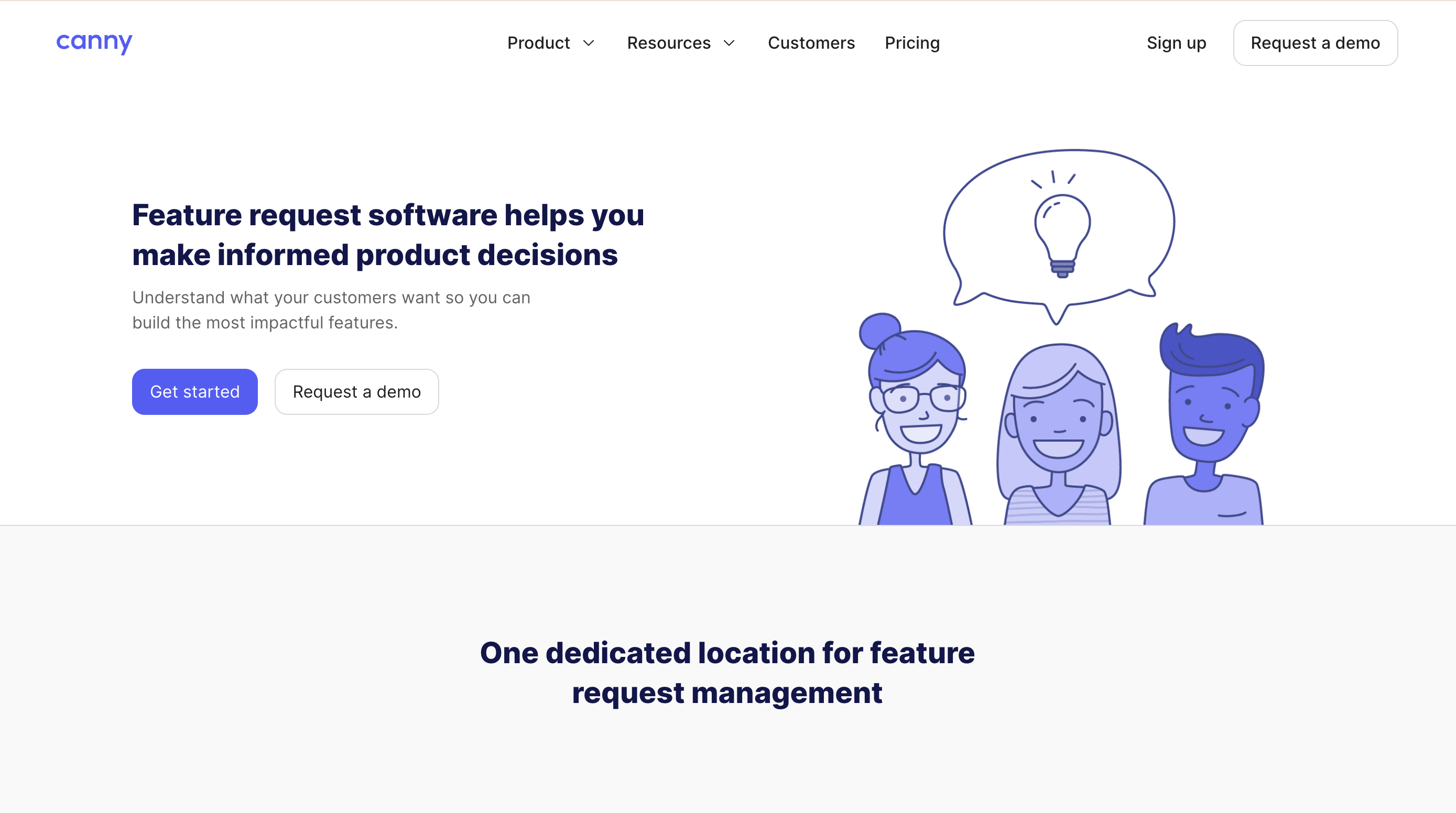
Canny grew up as a modern feedback board and roadmap tool focused on transparency with customers. It gives you public and private boards where users can post, vote, and comment on ideas.
What it does well
- Public and private feedback boards with voting, comments, and basic analytics.
- Simple roadmap views and a built‑in changelog for product updates.
- Integrations with tools like Jira, Linear, and Slack to connect feedback with delivery.
Best for
Use Canny if:
- You want to crowdsource priorities from customers and show them what's coming.
- You don't need deep portfolio strategy – just a clear place for feedback plus a simple roadmap.
It pairs nicely with strategic tools like Wey if you want to keep feedback and high‑level roadmaps separate but connected.
4. ProdPad – Idea Flow and Outcome‑Driven Roadmaps
ProdPad emphasizes idea management and outcome‑based roadmapping. It's built for teams that care about discovery and learning, not just pumping out features.
What it does well
- Structured idea workflows and feedback portals.
- Outcome‑oriented roadmaps, designed to communicate problems and results rather than feature lists.
- Collaboration features that help PMs connect ideas, experiments, and roadmap items.
Best for
Use ProdPad if:
- You want a tool that encourages continuous discovery and impact‑driven planning.
- You're okay with a more traditional UI in exchange for a mature product process toolkit.
If you only need clean presentation and simple stakeholder updates, a more focused tool like Wey or Roadmunk might suit you better.
5. Airfocus – Prioritization Engine with Modular Roadmaps
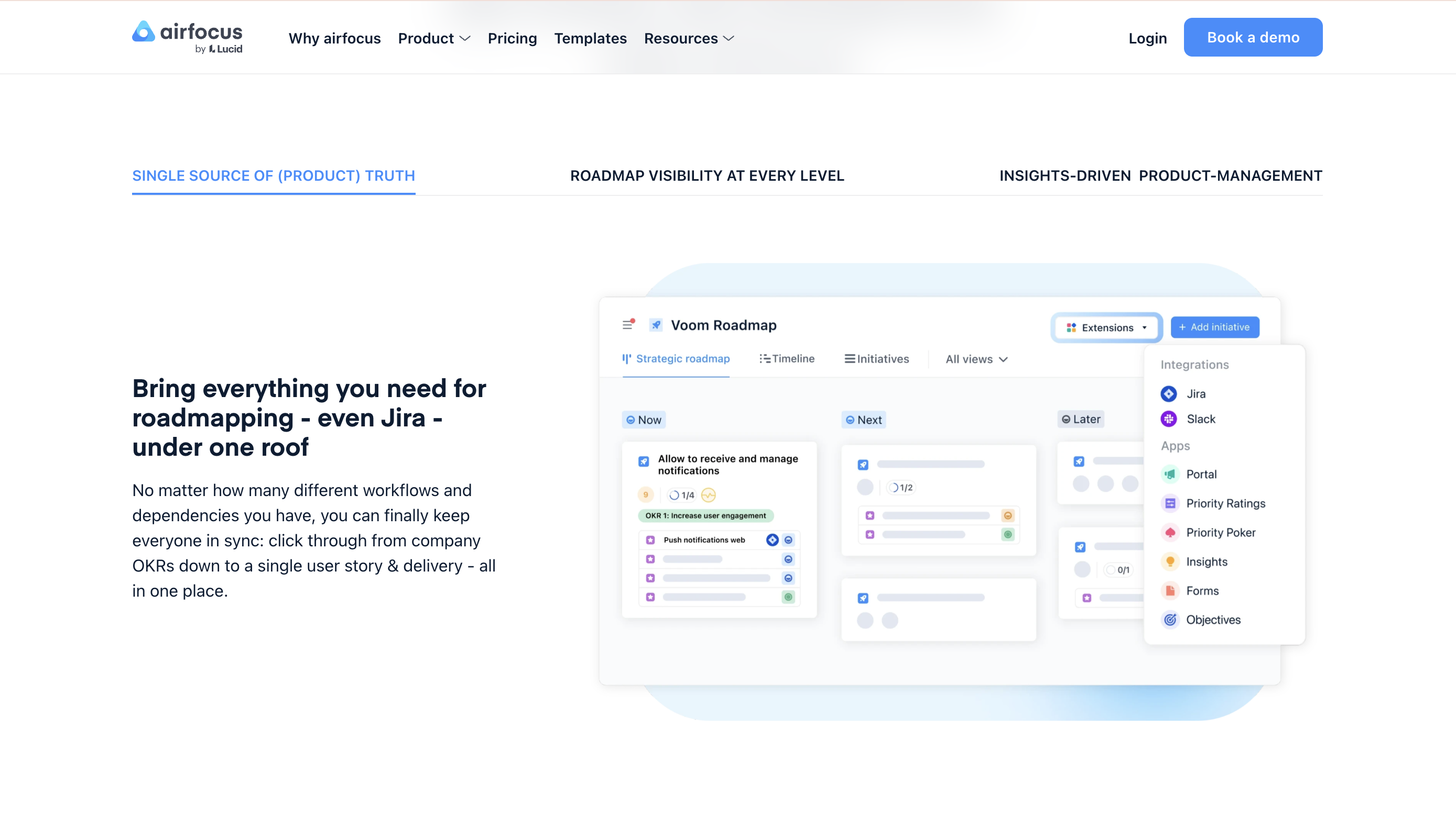
Airfocus is a modular product management tool with a strong emphasis on customizable prioritization models. It lets you score initiatives using frameworks you define, then translates that into roadmaps.
What it does well
- Custom scoring frameworks and prioritization models (RICE, MoSCoW, custom formulas, etc.).
- Modular roadmaps that adapt to different product lines and workflows.
- Integrations to sync with delivery tools.
Best for
Use Airfocus if:
- Your biggest struggle is prioritization clarity – deciding what to do next and justifying it.
- You like tweaking scoring models and involving stakeholders in trade‑off discussions.
If you want minimal ceremony and mostly need an easy‑to‑read roadmap, this degree of configurability might feel like overhead. Consider Wey's Priority Poker for a lighter collaborative approach.
6. Jira Product Discovery – For Teams Already in Jira
Jira Product Discovery (JPD) is Atlassian's discovery and prioritization layer for product teams working in Jira. It captures ideas, scores them, and connects them directly to delivery issues. See our detailed wey vs Jira Roadmaps comparison.1
What it does well
- Tight integration with Jira, making it easy to go from idea to epic.
- Flexible idea fields, views, and scoring models for prioritization.
- Lightweight roadmap and stakeholder views inside the Atlassian ecosystem.
Best for
Use JPD if:
- Your engineering teams live in Jira and you want a native discovery tool, not another silo.
- You're comfortable with Atlassian's UX and don't need glossy executive‑ready roadmaps.
If you need polished, narrative‑driven roadmaps for leadership, you may still complement JPD with a presentation‑friendly tool like Wey or Roadmunk. Wey also supports one-click Jira import to bring your existing projects over.
7. Roadmunk/Tempo – Visual Roadmaps for Stakeholder Communication
Roadmunk is all about visually clear roadmaps that are easy to present. It offers timeline and swimlane views, with strong filtering and sharing controls. Roadmunk
What it does well
- Timeline‑based and other roadmap layouts for different audiences.
- Presentation‑friendly visuals that non‑PM stakeholders can grasp quickly.
- Custom fields and filters to slice roadmaps by theme, owner, or customer segment.
Best for
Use Roadmunk if:
- Your main pain is presenting the plan to leadership, customers, or cross‑functional teams.1
- You're okay with managing feedback and discovery elsewhere.
It's less suited if you want a single system for feedback, prioritization models, and detailed research management.
8. ProductPlan – Classic Timeline Roadmaps
ProductPlan focuses on building and sharing timelines, swimlanes, and simple strategy‑linked roadmaps. It's closer to the classic understanding of a roadmap tool: communicate "what's happening when" without turning into a full product OS.
What it does well
- Intuitive drag‑and‑drop timelines.
- Simple link between initiatives and themes or objectives.
- Sharing options for different stakeholder groups.
Best for
Use ProductPlan if:
- You want a straightforward upgrade from slides and spreadsheets into something purpose‑built for roadmaps.
- You don't need advanced feedback, experiments, or analytics in the same place.
If you're looking for more modern, strategy‑first storytelling, Wey or Roadmunk might be a better cultural fit.
9. UserVoice – Enterprise Feedback and Research
UserVoice is built for organizations with lots of customers, stakeholders, and feedback signals to manage. It combines idea collection, voting, and more rigorous research workflows.
What it does well
- Feedback portals and idea tracking at scale.
- Research‑grade survey and feedback analysis features for B2B products.
- Strong support for product discovery and customer‑driven validation.
Best for
Use UserVoice if:
- You're overwhelmed by feedback volume and need structure, not just a place to dump requests.2
- You sit in a B2B environment with many accounts and stakeholders feeding into your roadmap.
You'll probably still pair it with a roadmap‑centric tool (like Wey, Roadmunk, or Aha!) for visual storytelling.
10. Pendo – Analytics‑Driven Product Decisions
Pendo is a product analytics and in‑app guidance platform that also includes feedback and roadmapping features. It's best seen as a way to tie behavior data to roadmap choices.
What it does well
- In‑app usage analytics, funnels, and cohort analysis.
- In‑app guides and messaging to drive adoption.
- Optional feedback and roadmap capabilities linked to real‑world usage data.
Best for
Use Pendo if:
- You want your roadmap and prioritization to be grounded in actual product usage patterns.
- You're ready to invest in instrumentation and experimentation, not just planning.
It's not the cheapest option and is overkill if you only need a roadmap and a place for ideas.
11. Trello (with Roadmap Power‑Ups) – Lightweight and Flexible
Trello is not a product management tool by design, but many teams still adapt it for lightweight feedback and roadmapping. With the right power‑ups and conventions, it can handle a simple idea‑to‑roadmap flow.
What it does well
- Extremely simple Kanban boards for ideas, "next up," and "in progress."
- Roadmap power‑ups and automations for basic prioritization and scheduling.
- Low barrier for non‑technical stakeholders to participate.
Best for
Use Trello if:
- You're an early‑stage startup or solo founder and want something familiar, free or cheap, and flexible.1
- You're not ready to define a full product process yet.
You'll quickly hit limits on reporting, strategy, and multi‑product complexity – at that point, migrating to a purpose‑built tool like Wey, Canny, or Airfocus makes sense.
12. Asana – When Project and Product Overlap
Asana is primarily a work management and project tool, but many teams use it to track product initiatives and lightweight roadmaps. It's often already in use in marketing, operations, or design, which makes it attractive for simple cross‑team alignment. See our detailed wey vs Asana comparison.
What it does well
- Flexible projects, boards, and timelines to represent initiatives and milestones.
- Good for coordinating cross‑functional work tied to product releases.
- Strong task management and execution tracking.
Best for
Use Asana if:
- Your product team shares a tool with the rest of the business and wants to avoid tool sprawl.
- You need execution visibility more than specialized product‑specific features.
It's less suitable if you want dedicated product workflows like idea portals, scoring frameworks, or discovery tools.
How to choose the right Productboard alternative
To pick the best fit, start from your primary constraint, not from feature lists:
- If strategy clarity and storytelling are your main gaps, start with Wey, Roadmunk, or ProductPlan.
- If feedback and discovery are the problem, look at Canny, ProdPad, or UserVoice.
- If prioritization and portfolio complexity are the pain, consider Airfocus, Aha!, or Jira Product Discovery.
- If data‑driven iteration is the goal, layer in a tool like Pendo alongside your roadmap stack.
One practical setup many teams end up with is:
- Feedback and discovery: Canny or UserVoice
- Strategy and roadmapping: Wey
- Delivery and execution: Jira, Linear, or Asana
That way, each tool does what it's best at, and your product team spends more time making decisions and less time wrestling with an all‑in‑one platform.
Next steps
Ready to try wey? Here are some helpful resources:
- All features — See the full capabilities including 7 views, Jira import, and stakeholder sharing
- Pricing — Generous free tier, no credit card required
- Getting started guide — Build your first roadmap in minutes
- Roadmap templates — Start with a proven template
- wey vs Productboard — Detailed feature-by-feature comparison
- How to create your first product roadmap — Step-by-step guide
- What is strategic product planning? — Align your roadmap with goals